


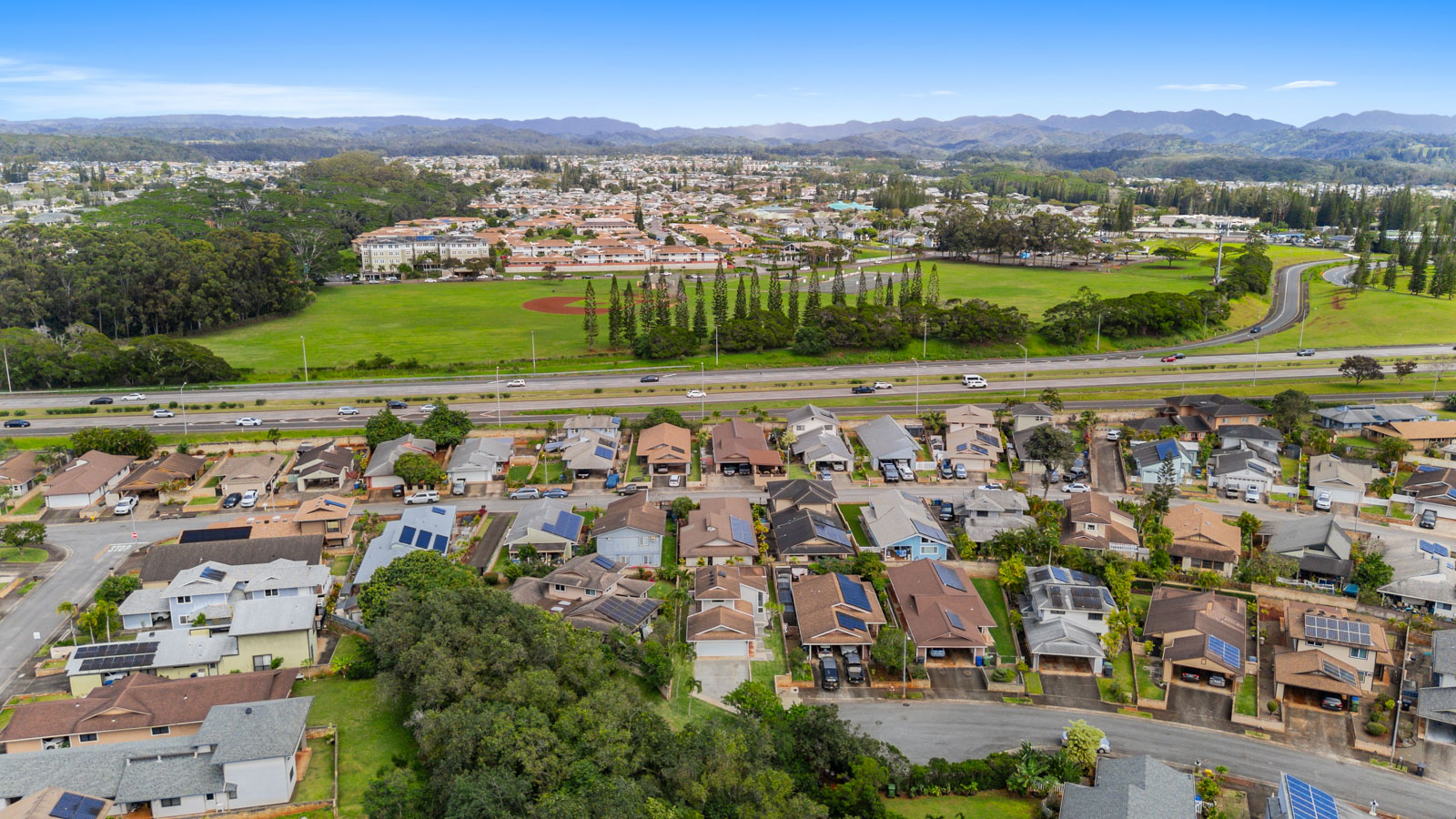
"Sellers won't take VA offers."
We hear that one constantly, and honestly, it drives us a little crazy — because we've helped VA buyers win offers on Oahu over and over again. The myth is stubborn, but it's also mostly wrong. More on that in a minute.
We're Kristy and Austin Nakamura, a husband-and-wife real estate team based right here in Mililani, brokered by eXp Realty. A huge portion of what we do — roughly 60% of our transactions — involves VA buyers. We work with military families every week, and we partner closely with Brendon Oshita at Queens Capital, whose business is about 85% VA loans. VA financing isn't a side specialty for us. It's our wheelhouse.
This guide covers everything a Hawaii military buyer actually needs to know in 2026: eligibility, limits, appraisals, costs, how to compete, common traps, and the quirks that are specific to buying on Oahu. Grab some coffee — let's get into it.
What Is a VA Loan and Who Qualifies in Hawaii?
A VA loan is a home loan backed by the U.S. Department of Veterans Affairs. The VA doesn't lend you the money directly — it guarantees a portion of the loan to the lender, which is why you can buy with zero down and no private mortgage insurance.
Who's Eligible?
In general, you may qualify if you fall into one of these categories:
- Active duty service members (typically 90 days of continuous service)
- Veterans who were discharged under conditions other than dishonorable
- National Guard and Reserve members (after 6 years of service, or 90 days under Title 10/32 activation)
- Surviving spouses of service members who died in service or from a service-connected disability
The VA's own eligibility page at VA.gov is the best place to confirm your specific situation, since there are several service categories and the rules have nuances.
Getting Your Certificate of Eligibility (COE)
The COE is the document that proves to a lender that you're entitled to use the VA loan benefit. You can request it three ways:
- Through your lender (the fastest option — most VA lenders pull it in minutes)
- Online at VA.gov through the eBenefits portal
- By mail with VA Form 26-1880
Don't wait on the COE before starting the homebuying process. Brendon can pull yours same-day when you apply for pre-approval.
2026 Hawaii VA Loan Limits and Entitlement
Here's where people get confused, so let's clear it up.
The VA technically doesn't cap how much you can borrow — but county conforming loan limits still matter in certain situations. Hawaii is treated as a high-cost area under FHFA rules, so the 2026 conforming loan limit for Honolulu County is $1,249,125 for a single-unit property.
Full Entitlement = Zero Down (Up to Any Amount)
If you've never used your VA loan benefit before — or if you've fully restored your entitlement after paying off a prior VA loan — you have full entitlement. With full entitlement, there is no loan limit. You can buy a $900K home in Mililani or a $1.4M home in Kailua with zero down, as long as you qualify based on income and the appraisal supports the price.
That's genuinely one of the most powerful features of this loan in a high-cost market like Oahu.
Partial Entitlement
If you currently have an active VA loan or had a prior VA foreclosure, you have partial entitlement. In that case, the conforming loan limit becomes relevant.
The math works like this: the VA guarantees 25% of the loan. Your remaining entitlement and the county loan limit ($1,249,125 for Honolulu) determine your zero-down ceiling. Anything above that ceiling requires a down payment equal to 25% of the difference.
Example: If you have $100,000 in remaining entitlement and you're buying a $900K home, you'd calculate:
- $900,000 × 25% = $225,000 needed in coverage
- $100,000 remaining entitlement already provides
- $125,000 gap = your required down payment
It sounds complicated, but Brendon runs this math on every file. The short version: if you have partial entitlement, get pre-approved early so you know exactly what your zero-down ceiling is.
The "Sellers Won't Accept VA Offers" Myth
Let's just call it what it is: outdated.
This myth started in an era when VA appraisals were unpredictable, VA loans closed slowly, and fewer agents knew how to work with them. In 2026, those problems are mostly gone — especially when you're working with agents and a lender who do this regularly.
Here's what actually makes sellers hesitant (and how you fix it):
They don't understand the loan. A lot of listing agents — especially those who don't work much with military buyers — have heard the myth and never questioned it. When we represent VA buyers, we often call the listing agent before the offer goes in and explain exactly how the process works with our team and Brendon. That conversation alone changes the dynamic.
They're worried about appraisal conditions. VA appraisals do have minimum property requirements (more on that below). But in most standard Oahu resale transactions, this is a manageable issue, not a dealbreaker.
What makes a competitive VA offer in 2026 Hawaii:
- A strong, lender-specific pre-approval letter (not a generic one)
- A local lender like Brendon, whose name sellers' agents recognize
- A clean, well-written contract with reasonable terms
- Confident representation — us calling the listing agent and explaining the process
VA buyers win on Oahu every week. Don't let the myth cost you offers.
VA Appraisals on Oahu: What to Expect
VA appraisals serve two purposes: they confirm the value of the property and confirm it meets VA's Minimum Property Requirements (MPRs). That second part is where buyers sometimes run into surprises.
Common Condition Issues in Hawaii Homes
On Oahu specifically, these are the issues VA appraisers flag most often:
- Termite damage — Hawaii has active termite pressure, and visible structural damage can require repair before closing
- Peeling or chipping paint (especially in older homes) — treated as a potential lead-based paint hazard
- Missing handrails on stairs
- Water heater straps — required for earthquake safety in Hawaii
- Broken windows or non-functioning utilities
Most of these are fixable. Sellers often agree to address them, especially in a well-presented offer. We know how to write repair requests that don't tank a deal.
The Tidewater Initiative
If a VA appraiser thinks the contract price may be above market value, they'll issue a Tidewater notice before completing the appraisal. This gives us the chance to submit comps and supporting data to justify the price. It's not a denial — it's a conversation. Appraisers who work the Oahu market regularly understand local values, and a knowledgeable team can often make the case.
Timeline
A VA appraisal on Oahu typically takes 2–3 weeks. Plan your offer timeline accordingly — we factor this in on every transaction.
VA Loan Costs: What You Actually Pay
One of the biggest misconceptions about VA loans is that they're expensive. They're not. Here's what the numbers actually look like.
The VA Funding Fee
The funding fee is a one-time fee that goes to the VA, not to your lender. It's typically rolled into the loan — you don't pay it out of pocket.
- First use, zero down: 2.15% of the loan amount
- Subsequent use, zero down: 3.3% of the loan amount
- Exempt entirely if you have a VA disability rating of 10% or more, or if you're a surviving spouse receiving Dependency and Indemnity Compensation (DIC)
On a $750,000 loan, first-use funding fee = $16,125. That sounds like a lot until you compare it to 5% down on the same home ($37,500) plus years of private mortgage insurance that never builds equity.
Seller Concessions
VA loans allow sellers to cover all of your standard closing costs (title, escrow, lender fees) with no cap, plus up to 4% of the home's appraised value in additional concessions. Those concessions can pay your funding fee, buy down your rate temporarily, or even pay off other debts to help you qualify. That 4% is on top of regular closing costs — it's not the total seller contribution.
That's a significant benefit that conventional buyers don't have. On many of our VA transactions, buyers come to the table with minimal out-of-pocket costs — sometimes just the earnest money deposit.
No PMI. Ever.
This one matters a lot in Hawaii's price range. Private mortgage insurance on a $900K conventional loan can run $300–$500/month. With a VA loan, you'll never pay it — regardless of your down payment. On a 30-year loan, that's potentially six figures in savings.
How VA Loans Compete in Hawaii's Market
In 2026, VA loans are genuinely competitive in the Oahu market. Here's why:
Appraisal protection. VA loans come with built-in protection — if the home doesn't appraise, you can walk away without losing your earnest money. That's a feature, not a bug.
No PMI. Lower monthly payment than a conventional buyer at the same price, which sometimes translates to higher qualifying power.
Zero down. In a market where 5% down on a median-priced home means $40,000–$50,000 out of pocket, being able to preserve cash is a real advantage.
VA Loan Assumability — A Feature Worth Knowing
VA loans are assumable. That means a future buyer of your home can take over your existing VA loan — including your interest rate — without refinancing. If you lock in a 6.5% rate today and rates climb to 8% in two years, your home becomes significantly more attractive to buyers because they can assume your lower rate. This is a genuine competitive advantage in a high-rate environment, and it's something most buyers never think about at purchase.
To write a winning VA offer in this market: get pre-approved with a local lender, have us call the listing agent before submitting, write a clean contract, and let us handle the explanation with the other side.
PCS to Hawaii: Special Considerations for Military Buyers
Moving to Oahu on orders is a different experience than a standard relocation, and the VA loan process has a few wrinkles worth knowing about.
For a full breakdown of the process, neighborhoods near each installation, and what to expect on the ground, check out our Mililani Military PCS Guide.
BAH and Price Range
Your BAH is the starting point for understanding what you can afford. In 2026, Honolulu County BAH rates for common ranks with dependents look like this:
- E-5 with dependents: $3,663/month
- E-7 with dependents: approximately $4,000–$4,300/month
- O-3 with dependents: approximately $4,300–$4,700/month
- O-4 with dependents: approximately $4,700–$5,100/month
BAH is tax-free and most lenders will gross it up — meaning they factor it as if it were taxable income to maximize your qualifying amount. Brendon does this on every pre-approval.
At current rates, E-5 BAH supports roughly $550,000–$650,000 in purchase price depending on HOA fees and insurance. O-3 to O-4 ranges get you comfortably into Mililani and other Central Oahu communities.
Proximity to Installations
- Schofield Barracks / Wheeler AAF → Mililani, Wahiawa (10–20 min)
- Joint Base Pearl Harbor-Hickam → Mililani, Pearl City, Aiea, Ewa Beach (15–25 min)
- Marine Corps Base Hawaii (Kaneohe Bay) → Kailua, Kaneohe, Mililani (30–40 min to Mililani)
Buying on Orders
You can start the pre-approval process with pending orders — you don't need to have boots on the ground. We do virtual showings regularly and can help you go under contract before you arrive. Brendon also runs free PCS briefings for incoming service members, which is a great way to understand the whole picture before you commit to anything.
VA Loan Mistakes to Avoid on Oahu
We see these mistakes weekly. Avoid them.
- Using a mainland lender who doesn't know Hawaii. VA loans have standard federal guidelines, but Oahu has local nuances — condo approval processes, AOAO docs, Hawaii-specific appraisal conditions. A lender who's done 500 VA loans in Texas may still be learning on your file. Work with someone local.
- Skipping pre-approval. In Oahu's market, an offer without a strong pre-approval letter is almost always passed over. Get it done before you start looking.
- Not asking for seller concessions. VA allows the seller to cover all closing costs plus up to 4% in additional concessions. Many buyers don't ask. Always ask.
- Getting talked into a conventional loan you don't need. If you have VA eligibility and no compelling reason to go conventional, don't. No PMI and zero down are hard to beat. There are rare situations where conventional makes sense — we'll tell you if you're in one — but the default should be VA.
- Ignoring VA assumability. When you buy, ask about the existing mortgage. And when you sell, make sure your listing markets the assumable rate prominently if rates have risen.
- Not factoring in HOA/AOAO fees for condos. VA approves condos on a project-by-project basis, and HOA dues count in your debt-to-income ratio. A $900K condo with a $1,200/month HOA is a very different loan than a $900K single-family home. Run the full payment before you fall in love with a unit.
- Waiting too long to start the process. Between pre-approval, finding the right home, appraisal timelines, and condo approval (if applicable), the VA loan process takes longer than a cash offer. Build in the time, especially if you're PCSing with a hard arrival date.
Working With a VA-Experienced Team
There's a difference between an agent who can work with VA buyers and one who does it every week.
When a VA appraisal comes in low, we know how to respond. When a listing agent says "the seller prefers conventional," we know what to say to turn that around. When a condo project isn't on the VA-approved list, we know how to check eligibility early so you don't fall in love with a unit you can't finance.
We also know who to put you with for the mortgage side. Brendon Oshita at Queens Capital is our go-to VA lender — roughly 85% of his business is VA loans, he does PCS briefings for incoming service members, and the Hawaii market is all he knows. Having a lender whose name is recognized on Oahu makes a real difference when offers are being compared.
Ready to Talk?
Mililani isn't just a market to us — it's home. Austin grew up here. We're raising our family here. And we've helped a lot of military families find their place in this community too.
If you're preparing for a PCS to Oahu, thinking about buying for the first time, or just want to understand what your VA benefit actually buys in today's market, let's talk.
Call or text us at (808) 670-1548, or email us at kristy@youroahuhome.com.
No pressure, no rush — just a real conversation about your situation.
Mahalo,
Kristy & Austin Nakamura
Your Oahu Home Team | eXp Realty
youroahuhome.com
.jpg) First-time buyers in Hawaii typically pay 1-6% of the purchase price in closing costs, depending on loan type, down payment, and whether they negotiate seller concessions.
First-time buyers in Hawaii typically pay 1-6% of the purchase price in closing costs, depending on loan type, down payment, and whether they negotiate seller concessions. Seller closing costs in Hawaii typically range from 3-10% of the sale price when working with a real estate agent. On an $800,000 home, that's anywhere from $24,000 to $80,000.